
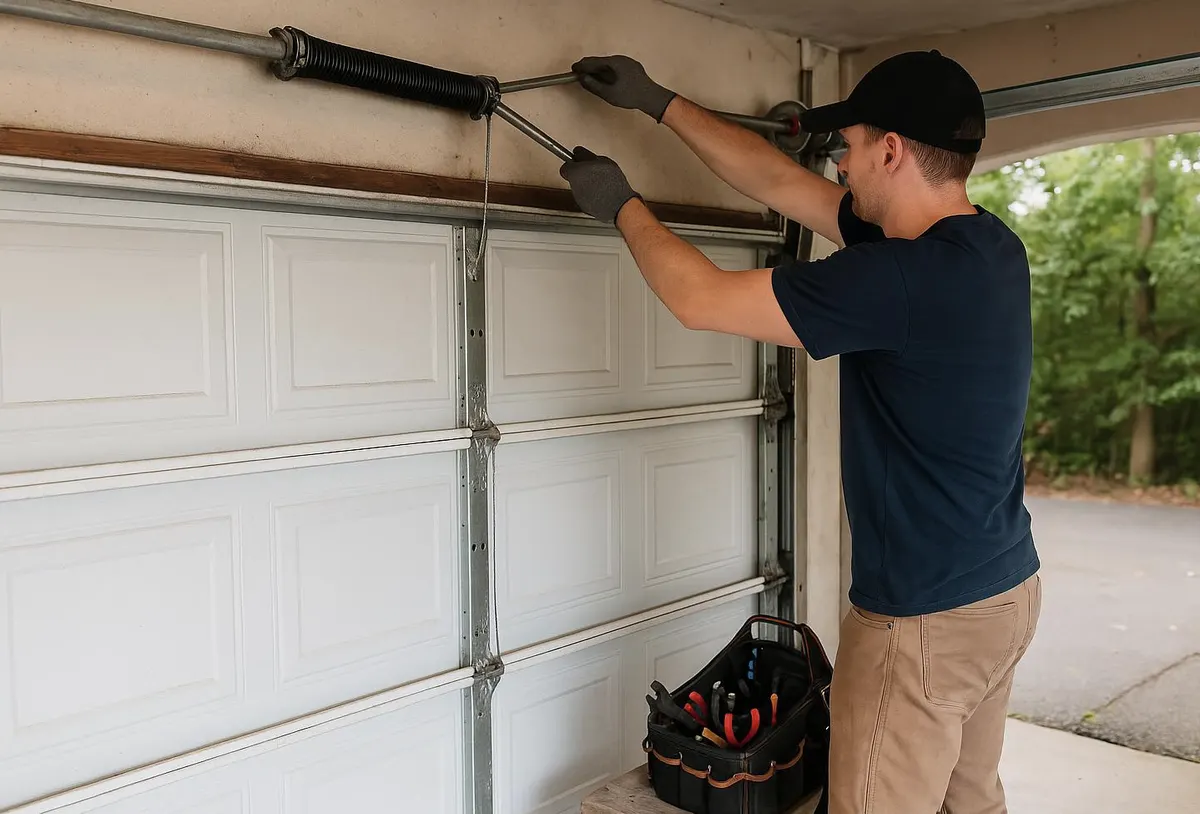
The Fix Everyone Tries First
The door reverses halfway down, or it won't fully close, or it slams the last few inches with a bang. The fastest fix sitting right there on the opener is a little dial or a menu labeled "force." Turn it up, and the problem usually goes away. That's exactly why it's the first thing people try, and it's also the wrong move almost every time. Cranking the force doesn't fix whatever is actually stopping the door. It just tells the motor to push harder until it muscles past the resistance. The underlying problem is still there, it's just getting overridden instead of solved.
If you and your spouse are arguing about whether "just turning it up a little" is harmless, this is the explainer to send them.
What Force Actually Controls
The force setting tells the opener how much resistance it's allowed to push against before it decides something is blocking the door and reverses or stops. It's a safety limit, not a performance setting. A correctly set force should let the door open and close smoothly under normal conditions, and should stop the door almost immediately if it meets real resistance, like a bike, a pet, or a kid's foot.
When the force is set too low, the door reverses on things that aren't actually obstructions, like a slightly stiff hinge or a little extra friction from cold grease. When it's set too high, the opener will keep pushing through resistance it should have stopped for, which means it's also pushing through resistance that shouldn't be there in the first place, like a binding track or a spring that's lost tension.
What Travel Limits Actually Control
Travel limits are different from force. They tell the opener exactly where "fully open" and "fully closed" are supposed to be, in terms of how far the trolley moves along the rail. If the down limit is set too far, the opener keeps driving the door into the floor after it's already closed, which is what causes that hard slam or the door reversing right at the bottom. If the up limit is set wrong, the door either stops short of fully open or strains against the top of the track, which stresses the opener's drive mechanism every single cycle.
Force and travel limits work together. A door with a slightly wrong travel limit will often need higher force to compensate, because it's being asked to push a bit further than it should. That's the trap: people adjust force to solve a travel limit problem, which hides the real issue instead of fixing it.
Why Turning Up the Force Causes Real Damage
A garage door opener is not meant to be the thing doing the heavy lifting. The springs are supposed to carry almost all the door's weight; the opener's job is just to guide the door along its path and provide a small amount of extra push. When the force is set high enough to overcome a real mechanical problem, like a weakening spring, a bent track, or a binding roller, the opener ends up compensating for a job it was never designed to do.
- Stripped gears inside the opener from constant high-force operation, especially on older belt or chain-drive units.
- Bent or torn panels on steel doors, because the opener keeps driving the door into an obstruction instead of stopping.
- Snapped cables when a door is forced through resistance caused by uneven cable tension.
- Burned-out motors from sustained strain cycle after cycle, which shows up as a opener that runs hot or hums longer than it used to before the door moves.
None of this happens overnight. It happens gradually, which is part of why the "just turn up the force" fix feels safe in the moment. The damage shows up weeks or months later as a bigger repair.
Why Loveland's Weather Makes This Worse
Big day-to-night temperature swings and genuinely cold winters change how a garage door behaves mechanically, not just how it feels to the touch. Metal track and hardware contract in the cold, which can tighten clearances just enough to add resistance that wasn't there in August. Lubricant on rollers and hinges thickens in low temperatures too, adding a bit more drag right as the sun goes down and the garage cools fast.
If your force setting was dialed up to compensate for that extra winter resistance, it will likely be too aggressive once temperatures swing back up during the day or when summer returns. Dry air and the stronger UV at altitude also degrade door seals and lubricants faster than people expect, which changes resistance over the course of a year even without anything breaking. A force setting that was "fine" in July can be hiding a real problem by January, and a setting cranked up in January can be too rough on the door by spring.
How to Tell If Your Settings Are Off
- The door reverses inconsistently, working fine some days and not others with no obvious cause.
- You hear the motor straining or running longer than usual before the door starts moving.
- The door slams down hard at the very end instead of settling into place.
- The opener light blinks a specific number of times, which most brands use to indicate a travel limit or force error — check the manual for your model's code.
When to Call Loveland Garage Door
If you've watched the door's behavior and it's still unclear whether the issue is the force setting, the travel limits, or something mechanical underneath both, that's the point to stop guessing. We check all three together: spring tension, track alignment, and opener calibration, because adjusting one without checking the others just moves the problem around. Our Opener Repair & Installation service includes resetting force and travel limits correctly for your specific door weight and track setup, and our Garage Door Maintenance visits catch the seasonal drag and resistance changes before they turn into a force setting that's quietly wearing out your opener.
If your garage door in Loveland, Fort Collins, Berthoud, Johnstown, Windsor, Longmont, Greeley, or Milliken is reversing, slamming, or just acting inconsistent as the weather turns, give Loveland Garage Door a call. We'll tell you straight what's actually going on, and get the settings right instead of just dialing up the power.